
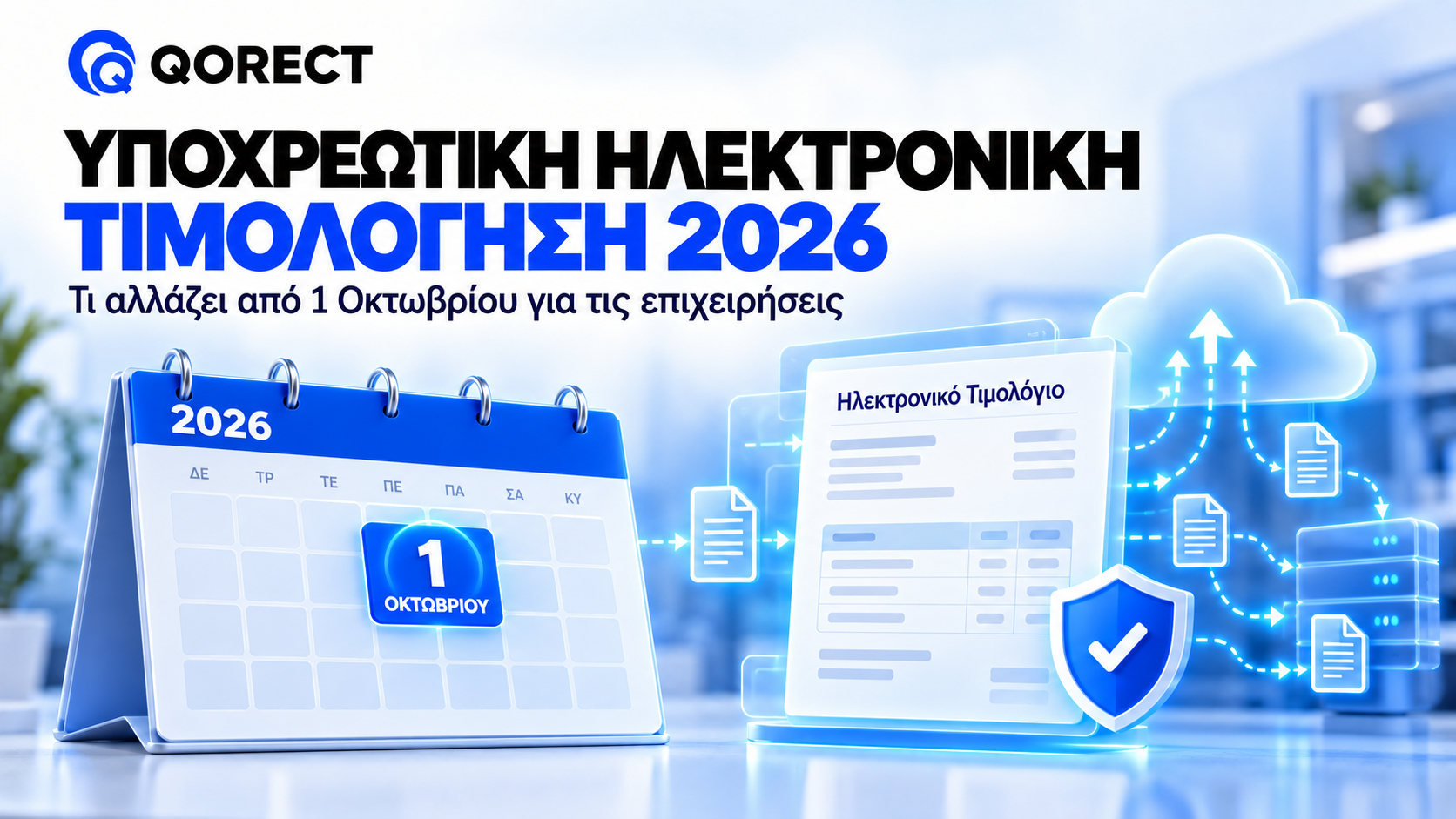
What changes from October 1, 2026, which businesses are affected, what applies until December 31 and how to prepare for the transition.
The change, however, does not simply mean that “invoices will be sent electronically”.
A business needs to understand:
- whether it falls under the second implementation period,
- which issuance methods are accepted,
- whether its existing ERP is sufficient,
- what applies to Providers, timologio and myDATAapp,
- what needs to be declared,
- what the period until December 31, 2026 actually means,
- and how the new process will connect with accounting and day-to-day business operations.
The AADE confirms that for the remaining businesses, following the first implementation period, mandatory e-invoicing begins on October 1, 2026.
What changes from October 1, 2026 in e-invoicing?
From October 1, businesses in the second implementation period must issue invoices covered by the relevant framework through one of the accepted e-invoicing methods.
Licensed Provider
Services of a licensed Electronic Document Issuance Provider.
timologio / myDATAapp
The AADE applications for issuing and transmitting documents.
Important: A conventional commercial or accounting ERP on its own is not an accepted method for fulfilling this specific obligation.
The AADE explicitly clarifies this in its frequently asked questions.
This does not mean that the ERP is no longer critical to day-to-day business operations. It simply does not constitute the required regulatory e-invoicing channel on its own.
Which businesses are affected by the second period?
The implementation of mandatory e-invoicing has been divided into two main periods.
The first period has already been in effect since March 2, 2026. For the remaining businesses, the obligation starts on October 1, 2026.
What about retail sales?
On September 22, 2026, the AADE announced that the implementation of mandatory e-invoicing does not change the way revenue documents are issued in retail transactions with final consumers.
The change should therefore not be interpreted as a general replacement of every receipt or retail revenue document under the new e-invoicing framework.
What applies until December 31, 2026?
This is where one of the biggest potential misunderstandings lies.
December 31, 2026 is not a new general start date.
The obligation for the second period officially begins on October 1, 2026.
The period from October 1 to December 31 is provided as an opportunity for gradual compliance, during which, under specific conditions, other existing issuance and transmission methods may continue to be used in parallel.
The AADE's important recent clarification
On September 22, 2026, the AADE specifically clarified what applies to businesses with gross revenues of up to €1,000,000 that wish to use the transitional period through timologio/myDATAapp.
The relevant declaration may be submitted by October 12, 2026, provided that the business wishes to use the transitional period from October 1 to December 31 and continue issuing invoices in parallel through existing methods.
By contrast, if the business issues invoices exclusively through timologio or myDATAapp from October 1, 2026, the AADE clarifies that this specific declaration of commencement is not required for those applications.
In other words: December 31 does not mean “I have another three months to deal with it”.
It means there is a specific gradual-compliance mechanism for businesses that meet the relevant conditions.
For businesses using a Provider, the declaration procedures set out in A.1112/2025 continue to apply.
How can a business comply?
There are two main routes.
Licensed E-Invoicing Provider
The Provider uses licensed software to handle the electronic issuance, authentication and transmission of the relevant documents.
With a Provider, transmission to myDATA takes place automatically and in real time when the document is issued.
The e-invoice goes through the relevant platform checks and receives the Unique Registration Number — MARK.
Particularly relevant for businesses that need integration with:
- ERP,
- customers and sales,
- orders,
- eCommerce,
- accounting,
- multiple locations or users,
- integrations and automations.
AADE timologio / myDATAapp
The second route is the use of the AADE's free applications.
timologio is a free application for issuing and transmitting documents and does not require a commercial Provider agreement.
The AADE describes it as a simple way of covering the relevant obligations, particularly for small businesses and self-employed professionals.
The obligation can likewise be covered through myDATAapp on mobile devices.
This does not mean that timologio is “the right choice only for small businesses” or that a Provider is always the better option.
The decision should be based on actual operational needs.
Provider or timologio: what is the difference?
The decision should therefore not start with the question:
Instead, ask:
Can a business continue issuing invoices only through its ERP?
No, if we are talking about the ERP as a standalone compliance channel for mandatory e-invoicing.
The AADE explicitly states that commercial or accounting management programs — ERP systems — do not by themselves constitute an accepted method for issuing e-invoices for this specific obligation.
This does not mean that you need to abandon your ERP.
In an organized commercial business, the ERP often remains the system that knows:
- who the customer is,
- what they are buying,
- what the price is,
- what has been sold,
- which order the transaction belongs to,
- which inventory is affected,
- which user is issuing the document.
The Provider can then act as the e-invoicing layer connected to this workflow.
This is exactly where the real business value of integration lies.
ERP and Provider: different roles, one connected workflow
ERP
Organizes commercial and business operations.
Provider
Covers the specific e-invoicing layer.
myDATA
The AADE platform where the relevant data is transmitted.
MARK is the Unique Registration Number associated with the document following the relevant myDATA process.
For the end user, however, the desired experience is not to think about four different systems every time an invoice needs to be issued.
The right implementation should make the process as seamless and connected as possible.
What changes in the day-to-day invoicing process?
The real change becomes clear when we follow the process from beginning to end.
The user creates the sale or relevant document within the appropriate business workflow.
When a Provider is used, the relevant document passes through the licensed e-invoicing system.
Transmission through the Provider takes place automatically and in real time upon issuance.
The document receives the required Unique Registration Number.
The e-invoice becomes part of the digital transaction with the customer.
The data must be available to the accounting function and align with the business's other commercial records.
The important point is that this does not simply create a new “invoice delivery channel”.
What should a business have ready?
The transition to mandatory e-invoicing requires practical preparation.
Transition Checklist
- Check whether you fall under the second implementation period.
- Document how you currently issue invoices.
- Choose between a Provider and timologio/myDATAapp.
- If you choose a Provider, check that it uses licensed YPAHES software.
- Complete the required declarations and activations.
- Check how the new process will work with your ERP.
- Map all invoice types issued by your business.
- Check customer and business-partner data.
- Run real tests before go-live.
- Confirm that myDATA transmission and MARK are working correctly.
- Coordinate with your accounting firm or finance team.
- Train the users who issue invoices.
- Define what happens in case of a technical issue or failed issuance.
- Confirm whether and under what conditions you can use the transitional period until December 31.
What should you pay attention to in the declaration?
If you use a Provider, the AADE states that the “Declaration of Commencement of Electronic Document Issuance” is initially submitted by the Provider through myAADE within 10 days from the effective date of the agreement. The business is notified and also has a specific period in which to accept or reject the action.
For timologio/myDATAapp, the recent clarification of September 22, 2026 distinguishes between two cases:
- if you issue exclusively through the applications from October 1, the specific declaration is not required,
- if you want to use the gradual-compliance period while continuing to use previous issuance methods in parallel, the declaration may be submitted until October 12, 2026.
Because declarations depend on the exact setup, the business should confirm the process with its Provider and accounting firm.
Solutions for Accounting Offices
What happens if a business does not comply?
The AADE is clear:
Failure to issue an e-invoice when it is required is treated as failure to issue an invoice, and the relevant penalties under the Tax Procedure Code apply.
It is not appropriate to assign one single “e-invoicing fine” to every case, as penalties depend on the specific circumstances of the violation.
The goal, therefore, is not alarmism.
It is timely business preparation.
FiscalSign and Plano ERP: from compliance to everyday operations
This is where Qorect has a natural place in the discussion.
FiscalSign is included in the AADE's official list of licensed e-invoicing Provider software.
At the same time, Plano ERP provides the business-management layer on which functions such as the following can be organized:
The logic should not be:
The better question is:
An indicative connected workflow is:
This follows a connected-ecosystem approach: FiscalSign as the e-invoicing layer, Plano ERP as the commercial-operations layer and Qorect as the ecosystem that connects them.
Discover FiscalSign
Do you need an e-invoicing solution that can become part of your business's actual processes?
Frequently Asked Questions
Prepare your business for October 1
Mandatory e-invoicing is not only about choosing a new issuance method.
It is about creating the right connection between invoicing → ERP → sales → customers → myDATA → accounting.
The more complex the business operation, the more important it is to design the transition as one connected workflow rather than another isolated application.