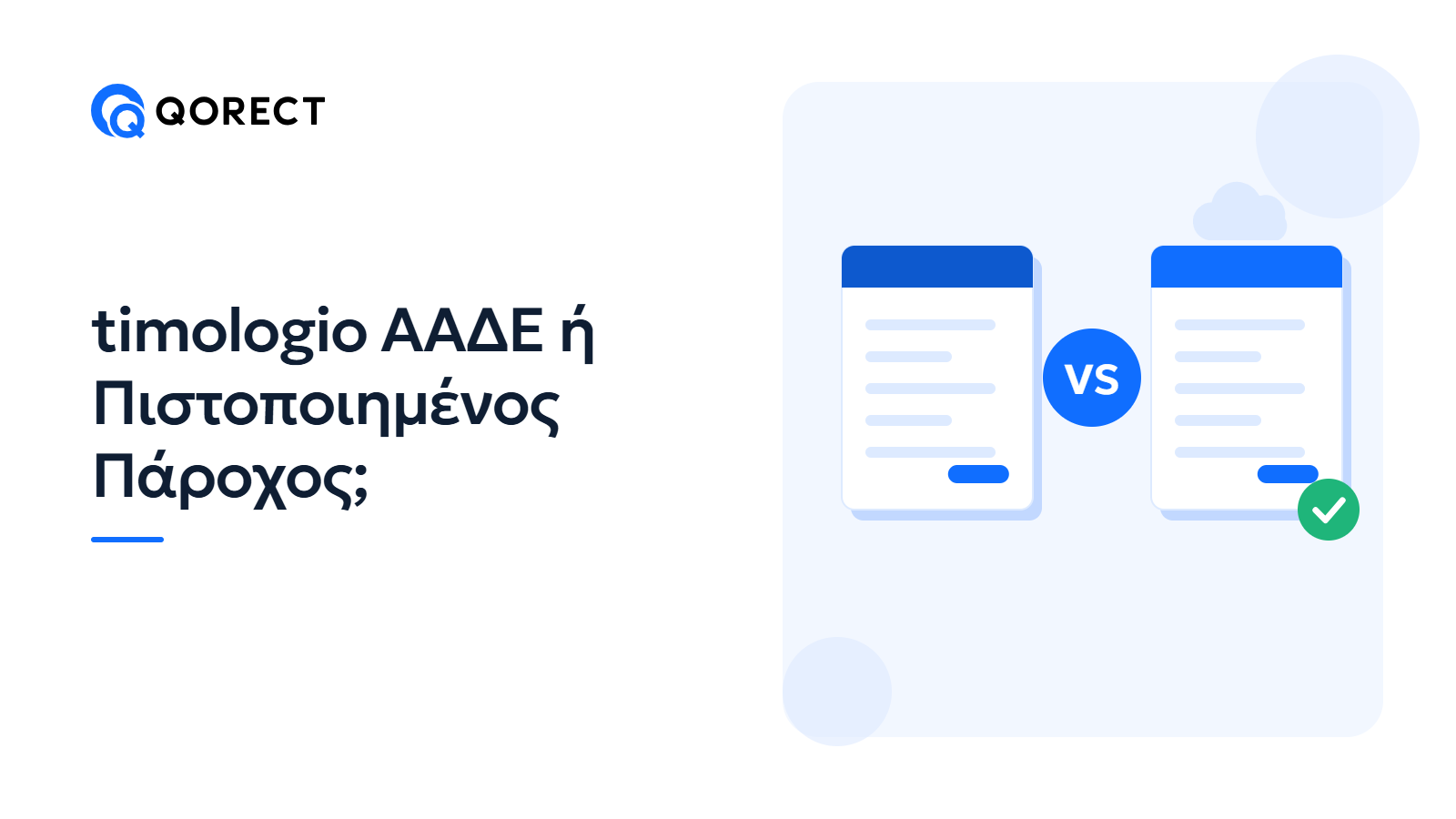
timologio is available free of charge through the Independent Authority for Public Revenue (AADE). So why would a business choose a certified e-invoicing provider instead? Both solutions can be used for mandatory e-invoicing, but the real difference lies in how invoicing fits into the business's everyday operations.
The question is not simply whether you pay €0 for the software. The important question is what the overall process costs your business in terms of time, manual work, integrations, support and scalability.
timologio or Provider: The Short Answer
timologio, together with myDATAapp, and the services of a licensed e-invoicing provider are the two issuance routes recognized by AADE for mandatory e-invoicing.
timologio may be worth considering when invoicing is simple, the number of documents is manageable and there is no need for deep integration with a wider commercial workflow.
A certified provider becomes more relevant when invoicing needs to be connected to an ERP, sales processes, an eCommerce platform, multiple users or automated workflows.
What Is timologio by AADE?
timologio is a free AADE application for the digital issuance of business documents and their simultaneous transmission to myDATA.
Through the application, a business can configure its profile, register customers, products and services, and issue the required documents directly within the AADE environment.
According to AADE, timologio is available to all businesses, with particular relevance for businesses with simpler invoicing needs. It is therefore not limited exclusively to freelancers or very small businesses.
How Does myDATAapp Relate to timologio?
myDATAapp extends the timologio experience to mobile devices. Users of timologio can issue documents through a smartphone or tablet, using the appropriate account and access settings.
What Is a Certified E-Invoicing Provider?
A business using a certified e-invoicing provider relies on licensed software for the authentication and transmission of tax documents within the applicable regulatory framework.
Provider software is licensed by AADE and is designed to transmit documents to myDATA automatically and in real time.
After transmission, the documents are processed and receive their MARK. Depending on the solution and the available integrations, the provider can also operate as an e-invoicing layer within the business's existing commercial workflow.
Do Both Solutions Cover Mandatory E-Invoicing?
Yes. The framework recognizes timologio/myDATAapp and YPAHES provider services as the two routes for compliance with mandatory e-invoicing.
Depending on the business and its setup, parallel use may also be possible.
An ERP, by itself, is not a third independent issuance route. Instead, an ERP can connect with a certified provider and become part of the overall e-invoicing architecture.
Is an ERP a Third Option?
No. A commercial or accounting ERP on its own is not the third autonomous option for mandatory e-invoicing.
Typical architectures include:
Business process → timologio / myDATAapp → myDATA
ERP → Certified Provider → myDATA → MARK
In other words, the decision is not simply timologio vs Provider vs ERP. The important question is how invoicing is incorporated into the business's overall operating model.
timologio vs Provider: Detailed Comparison
| Feature | timologio / myDATAapp | Certified Provider |
|---|---|---|
| Software cost | Free | Commercial service |
| Mandatory e-invoicing | Supported | Supported |
| myDATA transmission | Yes | Automatic |
| MARK | Yes | Yes |
| Mobile issuance | Through myDATAapp | Depending on the solution |
| Provider agreement | Not required | Required |
| Customers / products / services | Available | Depending on the solution |
| ERP integration | Limited / indirect | Designed for integration |
| Automation | More limited | More extensive possibilities |
| Multiple operational systems | Less suitable for complex environments | More suitable for integrated workflows |
| Support | AADE environment | Provider / software support |
| Complex commercial operation | Requires more manual handling | Can support integrated processes |
The key point is that both approaches address the same compliance requirement. What changes is the business logic, level of automation and day-to-day workflow around e-invoicing.
Cost: Why €0 Does Not Tell the Whole Story
The free use of timologio is a genuine and direct software-cost advantage. However, the total operational cost of invoicing may include much more than the software itself.
Manual work, data re-entry, integrations, support, reconciliation and the ability to scale can all affect the actual cost of the process.
This does not mean that a provider is automatically cheaper. The right approach is to evaluate the entire invoicing workflow and its impact on everyday business operations.
When Can timologio Be Enough?
timologio may be sufficient for businesses that issue documents independently, have a manageable volume, do not require complex integrations and can work comfortably within the AADE environment.
In these cases, the combination of free access and mobile issuance through myDATAapp can be a practical approach.
When Does a Provider Become More Important?
The role of a provider becomes more significant when an invoice is the result of a broader commercial process rather than an isolated action.
eCommerce → ERP → Customer → Product → Stock → Sale → E-Invoice
In this type of environment, integration, reduced data re-entry, multiple users, document volume and technical support become increasingly important.
This is not a universal rule. Each business should evaluate its own workflow, systems and requirements before making a decision.
What Role Does the ERP Play in the Decision?
An ERP can centralize customers, products, prices, orders, sales, inventory, payments and reporting, creating a unified commercial environment around the invoicing process.
Plano ERP supports commercial operations such as sales, purchases, orders, warehouse management and business partners, while additional services can include YPAHES, API Connector and eShop Connector.
Plano ERP → Commercial Transaction → FiscalSign / Certified Provider → myDATA → MARK
In this model, e-invoicing becomes part of the overall commercial architecture rather than a separate manual task.
What Applies to the timologio / myDATAapp Declaration from 1 October 2026?
According to the clarification referenced in the article, from 1 October 2026, a business in the second period that issues exclusively through timologio / myDATAapp does not need to submit a Declaration of Start of Electronic Issuance.
The article also notes that businesses with annual turnover of up to €1 million that wish to use the transitional period from 1 October to 31 December 2026 while continuing to use their existing methods must submit the relevant declaration by 12 October 2026.
The declaration requirements applicable to certified providers remain unchanged.
Can a Business Move from timologio to a Provider Later?
The choice does not necessarily have to be permanent. Depending on the applicable framework and the business setup, parallel use may be possible, and a business may also work with more than one provider.
This means the overall architecture can be reassessed as the business grows or its operational requirements change. Any transition should, however, be handled with the appropriate declarations and procedures.
How Should You Decide What Fits Your Business?
| Business Situation | What to Evaluate First |
|---|---|
| Limited volume and simple issuance | timologio / myDATAapp |
| Small and straightforward workflow | timologio or Provider, depending on needs |
| Existing ERP | ERP + Provider integration |
| Automated eCommerce orders | Provider + ERP + eCommerce integration |
| Many users or departments | Integrated commercial architecture |
| Multiple stores or locations | Common workflow and integrations |
| High document volume | Automation and total operational cost |
| Business growth | Scalability and future integration needs |
Simple Workflow
Evaluate whether timologio can cover your invoicing needs without adding unnecessary operational complexity.
Complex Workflow
Evaluate provider integration with your ERP, eCommerce platform and wider commercial systems.
FiscalSign + Plano ERP: When E-Invoicing Becomes Part of Commercial Operations
FiscalSign is positioned as the e-invoicing layer that supports the digital issuance and transmission of business documents, while Plano ERP manages the broader commercial operation.
The idea is not simply that timologio is basic and therefore you should choose FiscalSign. The real distinction is architectural:
FiscalSign
The e-invoicing layer for the issuance and transmission of business documents.
Plano ERP
The commercial management layer for sales, purchases, orders, inventory and business operations.
Qorect
A connected business ecosystem bringing together software, eCommerce, ERP and e-invoicing capabilities.
Frequently Asked Questions
Is timologio free?
Yes. timologio is provided by AADE free of charge.
Does timologio cover mandatory e-invoicing?
Yes. timologio / myDATAapp is one of the recognized routes for mandatory e-invoicing.
Do I need a provider if I use timologio?
Not necessarily. The appropriate solution depends on your business workflow and operational requirements.
What is the main difference between timologio and a Provider?
Both can support mandatory e-invoicing, but they differ in how invoicing is integrated into the wider business process.
Is an ERP a third e-invoicing option?
No. An ERP can be part of the architecture, typically working with a certified provider for the e-invoicing process.
What is myDATAapp?
It is the mobile extension of the timologio experience, allowing supported document issuance through mobile devices.
When is a Provider more relevant?
Primarily when invoicing is integrated with an ERP, eCommerce platform, sales workflow, multiple users or automated business processes.
What is FiscalSign?
FiscalSign is Qorect's e-invoicing solution, designed to become part of a connected digital invoicing and commercial workflow.
timologio or FiscalSign? Evaluate the Solution Based on Your Business
There is no single solution that fits every business. The right approach is to look at your document volume, commercial workflow, existing software, integrations, users and future needs, and evaluate e-invoicing as part of the overall business process.