
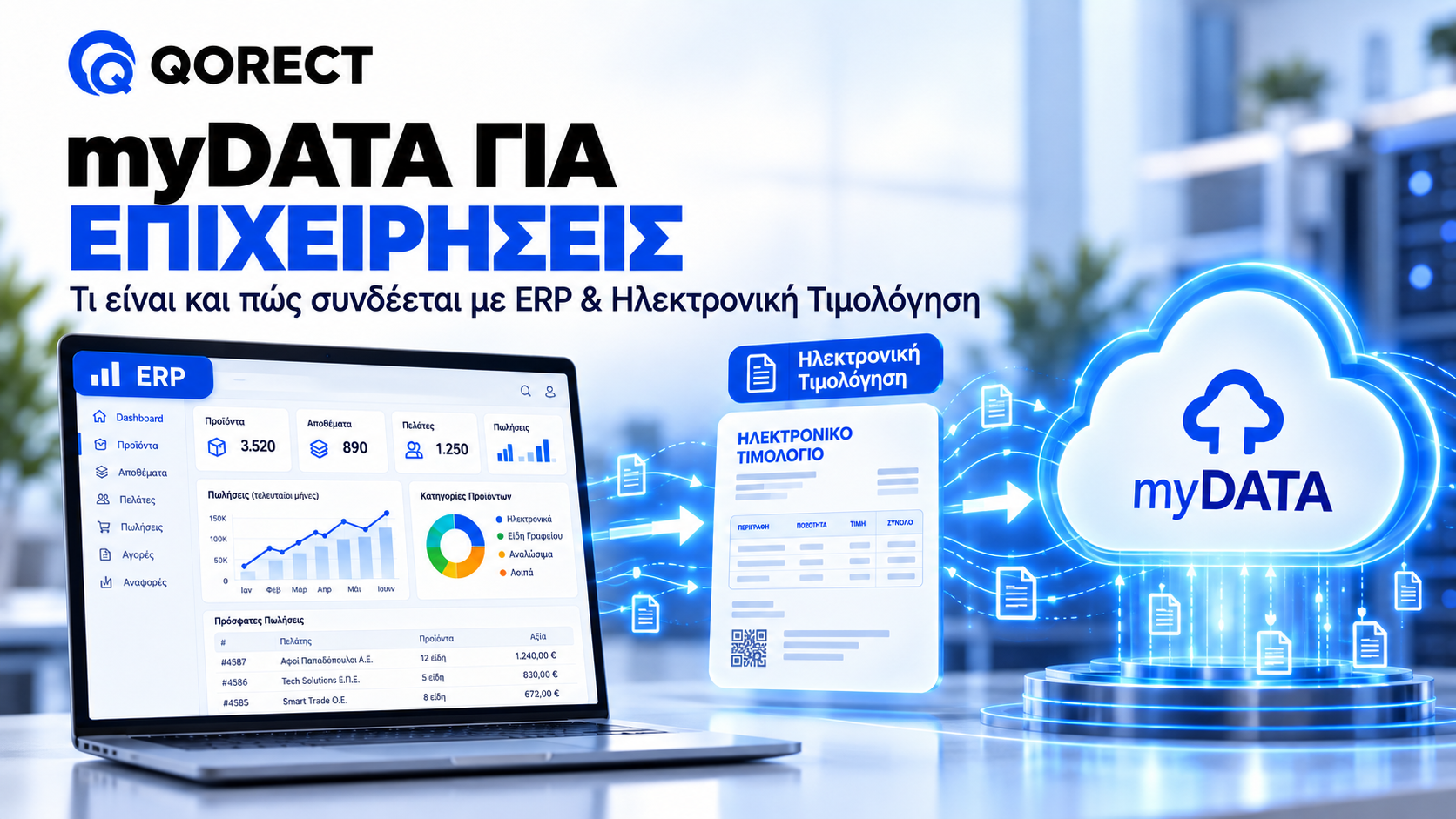
What myDATA is, which data is transmitted, what role the ERP plays and how myDATA connects with e-invoicing, Providers and accounting.
So what exactly is it?
myDATA — my Digital Accounting and Tax Application — is the AADE's digital platform for Electronic Books, where the required business transaction data is transmitted and presented.
To really understand how it works, however, we also need to look at what surrounds it:
This is exactly where much of the confusion begins.
A business may say:
or:
Both statements may be perfectly understandable in practice. They do not mean, however, that ERP, myDATA and e-invoicing are the same thing.
What is myDATA in simple terms?
myDATA is the AADE's digital environment where tax and accounting information related to business transactions is collected and presented.
Within the AADE Electronic Books:
- the required information and summaries of relevant sales and expense documents are transmitted and recorded,
- transactions are classified according to the applicable framework,
- the necessary accounting adjustment entries are made to determine the accounting and tax result.
myDATA therefore operates at the level of tax information.
It is not the system through which a business organizes all of its day-to-day commercial activity.
What does myDATA stand for?
The AADE uses this name for the electronic platform through which Electronic Books have become part of the daily tax operations of businesses.
What is recorded in the AADE Electronic Books?
This requires an important distinction.
“myDATA is an online copy of all the accounting books of the business.”
The AADE itself uses a more specific description.
Sales and expense documents
The required information and summaries of relevant documents are transmitted. This allows the AADE to maintain a digital view of the transactions covered by the system.
Transaction classifications
The information is not limited to the amount of an invoice. Transactions must be assigned to the appropriate categories and classifications according to the applicable accounting and tax framework.
Accounting adjustment entries
The ecosystem also includes the required adjustment entries used to form the accounting and tax picture of the financial year.
How does myDATA work in practice?
In a highly simplified form, the logic can be described as follows:
This is a conceptual workflow.
It does not mean that every type of transaction or every business follows exactly the same technical transmission mechanism.
The AADE provides different transmission channels within the myDATA ecosystem, including Providers, ERP systems, the special registration form and Fiscal Mechanisms, depending on the type of transaction and the applicable framework.
How is data transmitted to myDATA?
It is important here not to confuse general data transmission to myDATA with specific obligations such as mandatory e-invoicing.
There are different mechanisms.
ERP
The AADE provides a REST API for communication between businesses' accounting and commercial software and myDATA.
Through this infrastructure, ERP and other business software developers can connect their systems so that they exchange the required data with the platform.
E-Invoicing Provider
When a licensed Provider is used, the transmission of relevant documents takes place automatically and in real time when they are issued.
The documents go through the relevant myDATA checks and receive a Unique Registration Number — MARK.
timologio
timologio is different from myDATA. It is the AADE's free application through which a business can create and issue documents while simultaneously transmitting the required information to myDATA.
myDATAapp
myDATAapp is the official AADE mobile application that enables digital issuance and transmission of documents from mobile devices and also provides customer-management and financial-information functions.
myDATA = platform
ERP / Provider / timologio / other applicable mechanisms
Ways in which the relevant information is created and/or transmitted, depending on the case.
What is the difference between myDATA and ERP?
The ERP manages the transaction within the business. myDATA receives the required information at the AADE level.
Let's take a simple example.
The ERP may already contain:
- the customer,
- the product,
- the price,
- the order,
- the warehouse,
- the sale,
- the payment.
This is business information.
myDATA does not replace this functionality.
It receives the required tax and accounting information generated by the relevant transactions.
The existence of the AADE REST API specifically for connecting accounting and commercial software with myDATA clearly demonstrates this relationship: the two systems are different and need to communicate.
myDATA, ERP and Provider: who does what?
The ERP creates and organizes business information. The Provider can handle the e-invoicing layer. myDATA is the AADE platform where the required data is transmitted and presented.
What is the difference between myDATA and e-invoicing?
This is one of the most common points of confusion.
myDATA and e-invoicing are connected concepts, but they are not synonyms.
myDATA
The AADE's tax and data platform.
E-Invoicing
A specific process and method for the electronic issuance, authentication and transmission of invoices under the applicable framework.
So the statement:
is not necessarily correct.
Under the 2026 mandatory e-invoicing framework, the AADE directs businesses toward an ERP combined with a certified Provider or toward the timologio/myDATAapp applications.
This is different from the general ability of an ERP to communicate with myDATA for other applicable transmissions.
What is the difference between myDATA and timologio?
myDATA = the platform
timologio = a document-issuance application that transmits data to myDATA
timologio is provided free of charge by the AADE and allows businesses to create customers, products and services and issue digital documents, which are transmitted to myDATA at the same time.
timologio is therefore a tool within the broader myDATA ecosystem.
It is not another name for myDATA.
What is the relationship between myDATA and a Provider?
The Provider sits between the business issuance process and myDATA.
A simplified workflow can be:
The AADE states that documents issued through a Provider are transmitted automatically and in real time to myDATA and receive a MARK after the required checks.
What is MARK?
MARK — Unique Registration Number — is the unique identifier assigned by myDATA to the relevant registration where applicable.
In the e-invoicing workflow through a licensed Provider, the AADE states that MARK accompanies the e-invoice issued through licensed software.
For the everyday business, its importance is not in the technical format of the number.
It lies in allowing identification and traceability of the relevant registration in myDATA.
Does myDATA eliminate the need for an accountant?
And this is not simply a matter of opinion.
The AADE explicitly states that the introduction of Electronic Books does not eliminate accounting monitoring by the businesses themselves, while the accountant's role remains critical for the correct presentation of transactions in myDATA.
Digital transmission does not automatically turn every transaction into a correctly accounted transaction.
The following remain essential:
- correct classifications,
- accounting review,
- corrections,
- adjustment entries,
- overall tax monitoring.
How do ERP, Provider, myDATA and accounting work together?
The best way to understand this is to start before myDATA.
This system map makes the relationship between the different layers much clearer than a long technical definition.
What changes when a business has an eShop?
Let's assume that a customer makes an online purchase.
The actual process may start as follows:
This example shows why myDATA is the destination for the required tax data, not the entire business workflow.
The business event started much earlier.
What should you check in your ERP for proper myDATA integration?
An ERP should not be evaluated only by asking:
You need to evaluate how the entire process works.
One of the most useful questions is:
When a transmission fails, does the business know what failed, why it failed and who will resolve it?
This is much more meaningful than simply checking a “myDATA compatible” box.
Plano ERP + FiscalSign: how myDATA fits into a connected workflow
The natural connection with Qorect lies precisely in the separation of these layers.
Plano ERP — Business Operations
Depending on the edition, Plano ERP supports functions such as:
- sales,
- purchases,
- orders,
- quotes,
- customers and suppliers,
- products and services,
- warehouse movements,
- receipts and payments,
- price lists.
Qorect also offers additional capabilities such as YPAHES, API Connector and eShop Connector.
FiscalSign — E-Invoicing Layer
FiscalSign is Qorect's e-invoicing solution, positioned around more organized invoicing workflows and the reduction of manual processes.
FiscalSign is also included in the AADE's official list of licensed YPAHES software, with Provider code 025 and a licensing date of December 23, 2024.
myDATA — Tax Data Layer
myDATA does not need to become the ERP of the business.
Its role is different: to receive and present the required tax and accounting data at the AADE level.
The overall model therefore becomes:
The goal is not simply to “send data to myDATA”.
Frequently Asked Questions
Connect myDATA with Your Business Operations
Correct data transmission does not start with myDATA.
It starts with the data of the actual business transaction:
The better this information is organized from the beginning, the more cohesive the entire workflow can become.
Qorect can evaluate your ERP, e-invoicing setup and integrations so that myDATA becomes part of an organized workflow rather than an isolated daily obligation.